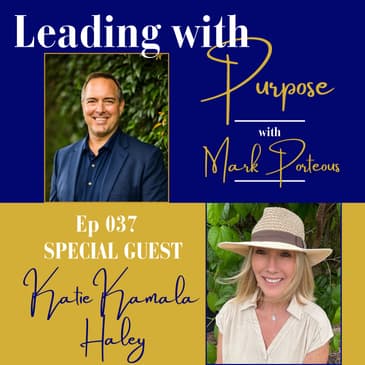
What if leading with purpose meant listening closely enough to recognize where life is guiding you? Mark Porteous speaks with filmmaker, herbalist, and Pineapple Peace Garden founder Katie Kamala Haley about the unexpected paths that shaped her journey. Katie shares how intuition led her from wellness and filmmaking to creating an edible food forest and living classroom where people can reconnect with nature, grow food and medicinal plants, and build self-reliance. Her story shows the power of starting small, learning through experience, and allowing dreams to unfold differently than expected.
Katie and Mark explore the connection between nature, community, embodiment, and purposeful living through permaculture, organic gardening, local food systems, and native plants. Katie shares her approach to leading with intuition and discernment by creating space for inner guidance, fact-checking before reacting, and choosing intentional action over fear. Her message is simple: everyone can grow something, dreams take time, and the path to purpose may look very different from what we imagined.
Key Takeaways:
- Starting before you feel fully prepared creates opportunities to learn through experience.
- A garden can become a practical teacher of patience, responsibility, gratitude, and reciprocity.
- Supporting local growers can strengthen relationships and resilience within a community.
- Native plants can help create healthier ecosystems by supporting pollinators and beneficial insects.
- Purpose can evolve over time rather than arriving as one clearly defined destination.
About the Guest:
Katie Kamala Haley is a women's wellness practitioner, herbalist, author, educator, with over 25 years experience working with medicinal plants.
She is the founder of Pineapple Peace Garden, a learning garden in Central Florida, where she shares her passion for medicinal plants, organic gardening, herbal wisdom, and sustainable living. Katie is also the author of Messages from the Medicine: Mother Ayahuasca Speaks and A Diamond for India: Myths, Magic, and Medicine.
Through her global work, Katie explores the powerful relationship between people and plants, encouraging others to reconnect with nature, cultivate wellness, and discover the wisdom that grows all around us.
Connect with Katie:
Katie Haley’s Website:
http://www.PineapplePeaceGarden.org
http://www.KatieKamalaWellness.com
Books:
https://www.amazon.com/author/katiekamala1
Social media:
http://www.Instagram.com/katiekamala1
http://www.facebook.com/cosmicflower9
http://www.youtube.com/katiekamalahaley
About Me:
Hi, I’m Mark Porteous; the Soul Connector.
My stand is for ALL people to recognize themselves as Divine Beings who have chosen the human experience for a reason and to live in alignment with that knowing, so they can THRIVE in their purpose of transforming lives.
I help mission driven entrepreneurs to make their Soul Connections so that they can impact and change the world, scale their businesses to six and seven figures, and enjoy thrilling Soul Success in every arena of their lives.
Connect with me at:
https://www.linkedin.com/in/markcporteous
https://www.instagram.com/mark.porteous1/
https://www.facebook.com/markcporteous/
Take the Soulful Leadership Assessment here: https://markporteous.com/#tve-jump-184964db927
Thanks for listening!
Thanks so much for listening to our podcast! If you enjoyed this episode and think that others could benefit from listening, please share it using the social media buttons on this page.
Do you have some feedback or questions about this episode? Leave a comment in the section below!
Subscribe to the podcast
If you would like to get automatic updates of new podcast episodes, you can subscribe to the podcast on Apple Podcasts or Stitcher. You can also subscribe in your favorite podcast app.
[00:00:03] Hello, welcome to Leading with Purpose, where elevating the consciousness of humanity is an inside job. We're bringing together visionary leaders to learn from their journey and shed light on our paths to leading with purpose, both business and life. The next step on your soulful journey starts right now. Hello, welcome to Leading with Purpose. I'm Mark Porteous and I'm very excited to have a conversation today with my very good friend of many years, Katie Kamala Haley,
[00:00:33] who wears many hats, filmmaker, writer, director, and world traveler, and founder of two ventures rooted in wellness and story. Through Katie Kamala Women's Wellness, she supports women in their health journeys and through Pineapple Peace Garden, which I'm really excited to talk about, a nonprofit sanctuary in Mineola, Florida, not too far from where I live. She's building a living classroom where people learn to grow their own organic food and herbal medicine.
[00:01:02] With over 50 species of edible and medicinal plants, including 40 tropical fruit trees, the garden is Katie's answer to a simple question, what if healing started in your own backyard? Hi, Katie. Good to see you. Hi, Mark. It's really great to see you and to be here today. It's been a long time since we've seen each other in person and it's really been fun. We've known each other for over 30 years. Hard to believe.
[00:01:31] And it's really been fun to watch your own evolution. I think when we first met, you were an esthetician. I was wrapping string in girls' hair. Yeah, we joke about how we've come a long way since then. But some things are still the same too, you know, with what our real purpose, I think our purpose manifests maybe differently than we thought. But we both, you know, especially about being writers and we loved, you know, poetry and spirituality.
[00:02:00] And that's been like, I think, the thread that's gone through it, even though we've done a lot of different ventures. Yeah, I think I really became aware of my spiritual journey when I was 22 and we met when I was 25. So I feel like you were a very key component in the foundation of my spiritual growth. So that's been really fun. And to watch you grow as one as a filmmaker, you know, I'm excited to see how that came to be because you've made several films now.
[00:02:28] And your Pineapple Peace Garden right in our own backyard, you're getting ready to have your fifth anniversary there already. So first, let me just go back a little bit of how this evolved. How long have you had the five years? Yeah. How did that first start? How did you decide to start growing an edible garden or an edible forest, really?
[00:02:55] Well, my interest in plants goes way back. So I would say of all the things I do, I mean, my biggest passion is the plants. It's something that I never tire of. I learn from every day. And I have studied as an interest, you know, well, I've been a certified herbalist.
[00:03:13] I had an aromatherapy company for 18 years where I was going to different countries and learning from farmers and getting distilled essential oils and selling them as part of my healing massage practice. But when I took courses on permaculture, I didn't have any land. And then I went and I moved down to South Florida where I was living in high rise apartment buildings. But I got into the community garden and I really loved that, renting a plot at the community garden.
[00:03:41] And even when I lived in Orlando, I had a small garden, but I was more of a hobby. I didn't take it as seriously. You know, and also back then, you know, YouTube and all the information at your fingertips really wasn't there like it is now. So I had studied it and I didn't have any land. And then after the pandemic, when so many people's lives changed, I came up to Central Florida where my parents have a property and they have a little under a half an acre.
[00:04:08] And I just was looking at all the grass and the weeds and I felt compelled to leave. It was really intuition to leave South Florida. And I saw my parents could really use my help. And I had a lot of friends and my sister and my nieces and nephews were in the Orlando area. And I just I felt like I needed to come back. And then I had this project. I asked my dad if he would help me. And he said, yes. So I built this little cottage in the garden that I'm in. And over time, I built a greenhouse and yoga deck. And we developed about a quarter acre of the property.
[00:04:38] And so that's where I am now. That's amazing developing a quarter acre because in a quarter acre, again, there's a lot there. It feels like you're in your own little paradise in that half acre backyard. Yeah, it is to me. And the template really or the garden really serves as a template. Of what people can do. And what I get so excited about is so many things now are generic and everyone's following the same trends. But everyone's backyard is different.
[00:05:08] Everyone likes to eat something different. Everyone has a different sense of style. And everyone has a different budget. And I've done this on a big budget. I think that inspires people because, you know, we see things on Instagram like Pamela Anderson, who I love and I follow her stuff. But she, you know, her she's got a huge garden in her backyard in Vancouver. But, you know, she's got a lot more money to spend on that. Or we see over the years people have liked people like Martha Stewart. Well, she's got millions of dollars, but most of us don't.
[00:05:36] So I think I can inspire people how to do things, whether they have a lot of money or whether they have a little bit of money. And not to let money really be the object of it. Because we all need to start small and learn and grow. And people think they have to know everything before they begin. But that's the wrong philosophy. We have to begin. And then we start knowing things and building on our knowledge. And it gives you a lot of sense of accomplishment. And you have a book that you just published.
[00:06:06] Tell us the full name of the book and how this relates to the work that you're doing. Oh, it definitely relates. So my book is Messages from the Medicine, Mother Ayahuasca Speaks. I think people are getting more familiar now with what ayahuasca is. When I started on the journey with the ayahuasca plant medicine from the Amazon, not too many people knew about it. There really wasn't things on YouTube about it.
[00:06:32] But I had met, well, I had a friend who was one of my first yoga teachers. And she married a shaman down in Miami. And she invited me to come and do a ceremony. And I knew very little about it. But I trusted her. And I went. And it was a beautiful experience. And I never thought it would really be a path now that's lasted 17 years. So after about six years of taking the medicine, I was guided to go to Peru. I ended up doing a writing residency there in the jungle. And that was a whole new world.
[00:07:01] I took a six-month sabbatical. And I wanted to give people a glimpse of these plants that a lot of times we take for granted, whether it's coffee or chocolate or many types of healing plants that are there. And also the Amazon itself, because that's the lungs of the planet. So I started out writing about the plants there, which I have another book from my two years of being in India.
[00:07:26] And that was all about the plants and kind of the culture and the magic of the plants, because they are quite magical, I believe. And then, of course, the ayahuasca is a visionary plant medicine. And it's very misunderstood. So I wanted to write a book, not just about my experience, because I feel like people learn best about things in a story. So it's my story in the beginning.
[00:07:49] But then the medicine over seven years was giving me these downloads that I was writing down that was messages really for humanity, not just for myself. And so my story is maybe the context, but then really it relates to everybody and what our journey is right now at this time on our planet. I wouldn't say it's prescriptive. You know, you need to do this or you should do that. But it makes people think. And I think that's important.
[00:08:18] I think any work of art, a film, a book, you know, it has to provoke some sort of question in us. You know, oh, how does this relate to me? And could I, you know, could I learn from this? And could I, you know, if I understand this, what is it going to do for me? Because, you know, it has to have something in it for you to want to read it or want to watch it. Right. Yeah, absolutely. I love your journey and your sabbatical into the jungle.
[00:08:45] I remember also learning a lot about cocoa, cacao. I don't know if that means you ignore the organic cacao. And we forget that this is medicine that has been used in a very, very different way, perhaps abused by our culture. But it came from their culture and it can have a lot of different medicinal values that we're not even often aware of. It does. I met a cacao shaman. I never even knew such things existed. A woman who had been working with the medicine said she was a young girl.
[00:09:14] And, you know, they have a different people that have not been exposed to the modern world have a completely different relationship with nature. And I saw that and I loved that. I mean, little children that we were going on a trek in the forest and they were talking about the trees, talking to them. And this tree told them this. And, you know, it's hard for people that have always lived in a modern culture to understand that.
[00:09:38] But the communication, you know, is different, whether it's a tribe in, you know, Africa or people in India, how they relate to the plants. And I love that. I love working with people and understanding and learning from people that haven't been completely engulfed in the matrix, which is what we're living, right? When I think of the matrix, everything that nature didn't make came from the mind of man.
[00:10:03] And sometimes that's good and sometimes it's not, depending on how it's integrated into the rest of the world. You know, when I came to live here on this property, you know, Claremont's known for its hills and it's really beautiful. It's why a lot of people are wanting to live now the hills of Niniola. But my parents have been here 26 years. It was just a huge forest. And someone said to me, oh, wow, what is that body of lake, that lake over there? And I never noticed it. And I said, that's because there used to be a forest there.
[00:10:33] And we're on the hill and we can see. And that forest has been, you know, cut down. So I, you know, get sad about that. Florida's dealing with, I think one of the biggest problems right now is overdevelopment and what's happening to the environment. So, you know, that's a problem. And when the forest is gone and when all these trees are gone, people have really lost a connection to nature when everything is highways and strip malls and, you know, big buildings.
[00:11:03] So having a sanctuary in your backyard, you don't have to go anywhere to get close to nature again. I mean, I have so many butterflies in here. The other day, my sister was here and she's like, what is that? I'm like, it's a hummingbird. And she's like, here she lives in Winter Park. She's like, there's hummingbirds? And I said, well, if you feed them and if you have plants that attract them, yeah, you can have hummingbirds in your backyard. And that to me is quite magical. Oh, it absolutely is.
[00:11:29] And the butterflies and yeah, all the rest of it, like I said, even the energy of it. What do people experience when they come to your Pineapple Peace Garden? Because you actually have like training classes and you're going to actually have an event for your celebration of your five year, correct? I do. And over the years, I've been having quite a few events. You know, the events are smaller. I mean, I can have, well, my events are smaller usually for teaching, but I did the garden. I was really proud of it just even a few years ago when I wasn't as far along as I have been.
[00:11:58] The Claremont Garden Club chose my garden as part of their tour. So kind of like when they do the celebration of homes. Well, this is like a celebration of gardens. It's their biggest event. And mine was the very first edible garden ever. It's usually they just pick, you know, fancy, beautiful homes that have really fancy gardens that probably have gardeners that take care of it. Or let's talk about that for a minute because I mentioned edible garden. When I think of a garden, I think of my mom's garden, which is all edible. It's literally a garden for cucumbers, tomatoes, lettuce.
[00:12:27] But most people have gardens here in Florida, especially that are botanical gardens. Is that what you're saying? Or what other kind of gardens are they showing in the garden show? Well, in the garden show, yeah, it's usually just really, you know, beautiful flowers. Like more ornamental or horticulture. Whereas the, well, permaculture is a whole other subject, but basically it's a seven-layer garden. And you have to have like these big canopy trees, which I have, let's say the mulberry tree, which grows quite big. That provides shade.
[00:12:55] Then you're going to have smaller trees, then bushes, then low-level plants, all the way to the root vegetables or ground cover, like sweet potatoes and, you know, ginger, things like that. So I've planted it in that way with the principles of permaculture. But I have a lot of fruit trees. So fruit trees is a big thing for an edible garden because you plant that and then that produces a lot of other things with shade for plants to grow and on and on.
[00:13:24] But when they chose me, I was really excited because my house, we say about the property, what people would expect. It just looks like an ordinary house. But luckily we have a corner lot and I finally talked my dad into letting me do a fruit forest in the front yard. He said, it took me a couple of years to give us to me, he said, you're not going to make a jungle in the front of my yard like you did the back of my yard. But he let me, it looks a little bit jungly, but not too bad. But you also had to be careful.
[00:13:50] The other big thing is if you live in a gated community, you're not really going to be able to do this. So we live on what was called Turkey Farm Road, which I'm sure had a turkey farm at one point. But in Florida, if you live in an over 55 community or a gated community, that just to me is a lot of regulation. So it's not this property. We don't have that. We do have a homeowner's association, but it's basically just simple things like don't paint your house a crazy color. Don't have garbage out front.
[00:14:20] But they don't, you know, it's not gated. They don't monitor things like that. And what I have is nice and actually most of it is behind a big gate anyway. But everything also had to go by the rules like this cottage here is, you know, all permitted and things like that, you know, through the city. But other than that, you know, I can grow whatever I want. So when people would expect they open up the back doors and like, wow, there's like a whole living ecosystem back here. I would have never, you know, figured on that. And that's what I want people to see.
[00:14:49] Like I said, it's a template. So I do have traditional, although organic garden beds going. I have, you know, all the trees. I have more like a shade garden. Then I have what grows in the sun. And when people come, especially the food forest workshops, they get a template. So they're going to like a blueprint. They're going to go in their backyard. Okay, where is east? Where is west? Where's north? Where's south? Even something that simple a lot of people don't think about.
[00:15:16] Like I had a neighbor that wanted me to help her and she didn't even think about that. And she said, well, can you come over and see what I've done? But she planted all her vegetables like in the shade. I'm like, well, it's not going to grow. And she wasn't too happy about that because she'd already done the work. But, you know, you have to have certain principles. You have to know, you know, how much, you know, rain is falling. And, you know, there's a lot of things. I wouldn't say it's complicated, but it's complex. And the fact that you have to, you know, you have to have some knowledge if you want
[00:15:45] to be successful, like any endeavor, right? Yeah. Yes. And simple instructions, you talked about a template and the template refers back to the permaculture. Yeah. And permaculture is like you said, the different layers, meaning from like high up to provide shade down to smaller plants, down to vegetation. Yeah. That's kind of like the seven layer forest garden. Cause we're trying, we don't have a forest, but we're trying to replicate what a forest does. And if you go in a forest, you don't see what we call a monoculture, one plant, right?
[00:16:14] You see, oh, there's pine trees and oh, there's, you know, things in the bush and there's, you know, things on the ground growing and all kinds of things. So, but permaculture is a whole system for living. Think of permanent agriculture. So it's things that would be close to your home. So we can use an example that if you're going to have a garden, things that you could pick to use every day, like in your cooking or to make daily tea, you would want to have it close in. So things that are based on a parameter. So things like that would be, you know, close.
[00:16:42] Whereas maybe the bigger trees and things would be more outside that take a while to grow. They're seasonal, but things that grow, like I can eat something out of my garden, you know, every day. That doesn't mean I'm going to feed myself every day. Like it's whole foods. Like my mom is really cute. She'll, I'll have some blueberries. Oh, are these two our garden? But it's like in December. I go, no, mom. That would be, you know, in March or I'm sorry, like in May and June, we get the blueberries. So things are seasonal.
[00:17:08] I like to teach the kids to, to the appreciation, like the pineapples I have growing. I named it Pineapple Peace Garden because that's the only plant I brought with me from my apartment. I had a pineapple growing on my balcony and a pineapple also is a symbol, you know, of welcome for everyone. You know, it was a big symbol of hospitality a couple hundred years ago and people could barely afford a pineapple. It was for the, you know, the rich. And now we just take it for granted through importing that we can have that. But it takes sometimes, you know, over two years to get a pineapple, one pineapple.
[00:17:39] You appreciate the pace of, of nature. You know, we're used to just ordering things on Amazon and getting it the same day. Well, you don't get a pineapple the same day, nor do you get cherries or peaches or, you know, what have you. And we get an appreciation for that. And you were talking about your mom who I adore and thinking about her, like thinking of it like whole foods or just having food on demand. And how useful is your garden? Like how much success do you use? Like do you use to make your salads? And you also talk about medicine.
[00:18:09] Like what are the different types of things that you grow? Okay. Well, you know, when I wanted, when I started this, I really wanted the concept to be, you know, people that have a, you know, food forest in their backyard, but I realized over time it can be overwhelming for certain people. So just that don't have land. I mean, the group I'm in, Lake County Permaculture, a lot of people have land. So we meet once a month and, you know, we talk about these bigger concepts of being sustainable.
[00:18:35] Like, you know, I'm growing things to, I have a compost and growing things to make my own fertilizer, even if someday the fertilizer was off the shelf. But for people to start small, I'm really getting into helping people, particularly women, start an apothecary garden. So that would be your herbs for cooking and your herbs for making tea and even, you know, tinctures and making medicine, which I teach people how to do. And that's really fulfilling.
[00:19:02] It feels good to be able to take care of yourself and your family to know a few basic things. Or I grow trees like moringa. And if you live in Florida, you can grow moringa, which is like the miracle superfood tree indigenous to India and Africa. And it has every kind of nutrition, every kind of vitamin. You can, you know, take the leaves and the pods, you can cook the seeds kind of like edamame, or you can powder the leaves and make it into, put it in your smoothies and make capsules.
[00:19:31] And, you know, people know. I've never heard of moringa. Yeah. How is it called moringa? I'm going to have to give you some for your house. M-O-R-I-N-G-A. It's like a miracle tree. So, you know, all kinds of things to, you know, to be useful. And I help people with, you know, well, especially for Florida, people that come locally, you know, what grows here, you know, to know what your growing zone is, you know, because some things, okay, I love lavender, but lavender doesn't love Florida. You know, lavender can grow really well.
[00:20:01] In California, if you see lavender farms, it's going to be in a different type of, you know, lavender is indigenous to France, has very different climate than we have here. The soil is different. The climate is different. So, you know, to know that and to know, you know, what your parameters are. So that's helpful. Yeah. I know one of the flowers that I love a lot is hibiscus and they grow very well here, but we also now live near deer and deer love to eat hibiscus. Yeah. You're out in nature now.
[00:20:31] I love your place. I'm sure as I'm seeing, I'd like to come visit sometime. I'll bring you some plants. Oh, that sounds good for sure. Sure. So I am curious again, the films, I'm curious how you started first making your first film and then that led into a second. It's just an interesting part of your journey. And I'm just curious how that happened. Oh, thank you. Well, you know, I talk about that in the book and the film thing was really like a happy accident.
[00:20:59] I really just wanted to learn how to make videos for my business. I had a yoga massage studio in South Florida and everything had really turned from, you know, remember in the beginning of Instagram was really just pictures, you know, it was to be artistic. You put a picture and followed other people and saw nice pictures and then everything turned into video. Well, I'm, you know, from also having a background in massage, I'm a real hands-on learner. So to try to learn video editing just by a tutorial was really difficult for me.
[00:21:29] I'm like, well, I just want to find a class. I'm sure there's some class that can teach me to do video editing. But when I did a search, there really wasn't. And there was, you know, Palm Beach State, which was, you know, now the state college used to call them a community college. And I thought, well, I can just go and maybe take like a night class. I already had a college degree. I didn't want to go back to college. But as it turned out, I had to sign up for the whole college again. But what was strange was I just felt really compelled, like even like intuitively like, why am I doing this?
[00:21:58] Like, this is such a hassle, like just to go learn this. But I felt compelled, like I needed to do it. And then I get signed up for the whole thing. And it's like, oh, well, now the editing class isn't until like the next semester. I'm like, you got to be kidding me. Well, like a cinematography. So I ended up signing up for the cinematography program. And once I got in at the professor who was my age, all of the students were very young. And he's like, you know, why don't you take this and take this? And I got financial aid.
[00:22:27] And I just when I got a grant and I was like, you know what? This just seems kind of fun, something different for me. And then I found out I really had a talent for it. And I really enjoyed it. And, you know, we had to do projects, of course. So that's how the first couple of films were, you know, projects. And then I entered them into film festivals with the, you know, encouragement of my professors. And I, you know, I got some accolades and I said, wow, this is really, you know, interesting. So, yeah, I never, you know, it was just really a basic idea.
[00:22:57] I didn't think. But then I thought, wow, you know, everyone's consuming things now video, you know, video and people not having the time to, you know, or the want to read a book. Even now, a lot of people listen to books on audio and people like their content in a different way. So as far as now, it's been good because I have those skills and I can, you know, film things in the garden and I know how to do video editing and I have a lot of fun with it now. Yeah.
[00:23:26] And tell me, it's Spanish lesson. Is that the first one that started? That was, yeah, that was on my spring break. I went to visit my friend in Colombia who he was just Israeli friend of mine who had gotten involved with this really lovely Colombian woman and they invited me, he invited me and then I had never met her. And then I just was like, I took all my equipment and I said, you know, I'd really like to make a short film while I'm here.
[00:23:53] And they were all, you know, they were all good with that and we had a great time and it was, it was awesome. I was right before the pandemic. I came back to sort of the week of the pandemic. I'm in the, in the airport in Colombia was seeing people with masks on their face. I'm like, what's going on? Cause you know, I really didn't pay a lot of, I kind of was in my own world as far as, you know, school and working with clients as a therapist and I didn't pay a lot of attention. I didn't have a TV or anything like that. So that just kind of shifted that, you know, shifted everything. Of course.
[00:24:24] And for anybody who's interested in checking out your films, do you have a special page just for that? What is your website? Oh yeah. Well, I do have a website, Katie Kamala films, and I have a YouTube channel and it's fun. And it's, it's nice to support, you know, filmmakers and see something different. But I am putting together a documentary about the permaculture movement just here in Lake County. And now I do have someone I worked with that he's been producing a lot of short films. And I really believe that probably next year that we're going to start on that.
[00:24:53] Actually, we're going to be filming some things at the garden in October. I have a filmmaker he teaches and he's really good cinematographer and he's going to come and do that with me. So I, I do, that is a passion of mine, but I have, I have a lot of passions and now I'm really an interest, really trying to think of what is my main thing. And that is, you know, promoting the garden because I feel like our, our food system is really contaminated right now for lack of a better word.
[00:25:19] And I don't think, I mean, it's my opinion that it's all an accident that all of a sudden, oh, all of this is contaminated and all these blueberries are contaminated. All, you know, what is going on? I mean, food is essential, right? Our food, our water, our air is essential. And it's a big importance to me, the little bit I can do, which really is forming community. That's actually just like you. This is community, I think is the most important thing right now.
[00:25:44] And to find people that we trust and people that we can help each other, learn from each other. And in the days to come, I mean, that's really going to be important. I have a friend, not to digress, but my, a friend who I knew from Orlando that's been living on the big Island in Hawaii and she's been off grid and doing some really cool things. And right now, you know, I've been seeing what she's posted about these hurricanes and things that have come or these storms in Hawaii that have knocked a lot of things out. And you know what?
[00:26:14] There's no one really there that's helping them out. I mean, except themselves. There's not some big FEMA that's there fixing everything. There's going to be, I mean, with things with disasters and the way the world is changing, whether people want to say it's natural climate change, it's being, you know, perpetrated on us by the government, whatever. The point is the same, is that no one really is going to be there to save you, but your community. That's all who you're going to be able to count on.
[00:26:42] My good friends where I used to live in Asheville, I go every year and Marshall, my girlfriend, one of my best friends that lives there. I mean, it happened there just two years ago with Helene, a hurricane in Asheville, who would have thought? And really, I mean, they did get some help, but it's mostly the community. So we really have to pull together and get off of our screens and get into our community. I mean, I love the computer too.
[00:27:05] I, I, I'm on it quite a bit, but I also attend things at my local community and I, I'm really stressed the importance of that for all of us. Well, let's talk a little bit more about community and gardens. Cause I love the fact that you're helping people really create sovereignty by, by being able to have access to these things. But, uh, even a half acre land, some people may not have, but the idea of having local buying local, that's another important thing for many, many different reasons.
[00:27:34] Tell us a little bit about that and organic for people who may not understand. It's not about a health benefit that there's not greater nutrition as much as you're not getting toxins because you're eating organic. And when you grow your own, that's how you get organic. Like, absolutely. And I mean, I used to just be so distraught over the fact that we have to pay all this extra money just to not be poisoned.
[00:28:00] However, I mean, growing organically is a whole other thing. And I see how hard it is. For example, I just had some peppers and if you grow in the summer when it's hot, there's a lot more bugs and I wasn't on it every day or even spraying something natural. Cause I don't spray anything on anything here. And really the bugs just ate it. I did get all my jalapenos, but my regular peppers, no. Or, you know, when you grow this, you understand.
[00:28:24] So when I had a crop of peppers and they were small and I'm like, oh, like, oh, what did I do wrong? Well, someone that knows a lot more said, yeah, Katie, you're comparing this to things that grow in a hot house in California with lots of fertilizer and things that make it get, you know, big. And when you grow it naturally, it's not a lot of things too. When you grow naturally, like mulberries, you pick them and you have to eat them right away. They perish very quickly.
[00:28:51] When you grow your own, you also see, wow, this is going bad in like two days after I pick it. How can this be that things are on the shelf in the grocery store like they are? So it's a complex subject, but it's really important that we're going to have to find new ways for our food systems coming up. And, you know, I don't think the GMO is the way to go, but it's also, you know, difficult to grow organic. And it's just what you said.
[00:29:19] We really need to still support farmers do this because if not, we're going to be relying on a completely corporatized system to grow our food for us. Right. And I remember when Renee and I used to go to the little food market and, or the little garden markets, like literally on the corner and different farmers would bring them there. What are some of the ways that people can support their local farmer? Like how do you find places to buy vegetables outside of the grocery store?
[00:29:49] Yeah. And, you know, even the farmer's market in Claremont, there's someone that comes out there, but they're like a broker. So they're just getting stuff and not necessarily organic, but it is local. You know, a lot of things you don't have to have that way. Cause to me, if it's local, it's fresher, you know, you get some good wash. You could, there's a lot of ways, baking soda, white vinegar, or just a simple spray, which you can get the grocery store and spray and clean your, your food and, you know, buy local.
[00:30:17] So you just go online and there's all kinds of, now there's different, you know, websites to find local, but there's something called a CSA, Community Supported Agriculture. And you pay the farmer for that season and then you get like a box of everything. So it helps the farmer know, and we have an income to grow the food. So they're basically growing their food for their membership, their subscription.
[00:30:42] And that's a good way I'm doing, I'm not providing, I'm getting it from other, you know, other people. Because with my, what I'm doing here, I'm not just specifically, you know, growing vegetables. I'm creating a living ecosystem and showing people, you know, how to do that. So I'm not focused on one particular thing. Like I'm, I'm not growing enough. Like people have the wrong idea. Like there was someone who said to me like, oh, you know, you're feeding your whole family now. I'm like, well, not exactly. I mean, that's very hard to do.
[00:31:12] That's why if more people do it, we can trade. Like I just had a banana harvest or like 40 bananas, but I have to freeze them. I mean, I'm not going to be able to eat 40 bananas before they perish, but I could trade some of those bananas with some neighbors. And, you know, again, that's creating community or people that come here usually will bring me a plant. Or when I go to someone's house, I bring them something or help them grow something. So it's really that kind of idea and that kind of practice that I see we don't have,
[00:31:40] you know, here in our culture and how we can bring that back. Maybe, you know, we're never going to go back to the old days, but what can we do today to make things better for all of us? I love it. One of the things I was thinking about, especially you work a lot with kids and teaching them about plants. And I remember in fifth grade, my son bringing home a Monstera Deliciosa, which is water two leaves, very small. And then having them water it every day and watching it grow in our kitchen until it was this giant.
[00:32:10] Now it's out on our patio with six giant leaves. And if we put it in the ground, it would grow even more. I just think about the importance of caring for something, about keeping something alive. We don't have pets and those who do have pets, you know, the responsibility of taking them out and cleaning up after them and everything else is important. But I think the idea of, for me, I enjoy just literally watering my plants, make sure they get enough sun and not too much sun, all of those things. Yeah.
[00:32:36] It's a sense of wonder, you know, with the kids and a lot of people that are in the kind of field that I am and maybe they probably work more with kids than I do. I don't work a lot with kids. I'm mostly, you know, teaching adults and a lot of women. I mean, my other business is women too. And really it's mostly the women that, you know, tend to the garden and I'm saying guys don't do it too. But the sense of wonder and people always say like the kids don't know, you know, or you talk about these like school gardens.
[00:33:05] And I'd have friends that have done school gardens and that a lot of the kids, especially like if they live in cities, have no idea that carrot grows underground. They're like, wow, really? And, you know, just the idea of knowing that because they will get a different sense of the world. And if everything becomes so completely corporatized that we lose that sacred connection with the
[00:33:32] earth and food is a big, you know, a connection and it should be a sacred way. But when people just order food from a drive-thru and eat it in their car, there's nothing, you know, sacred or, you know, feeling a sense of really gratitude for it. Like when you grow it and when you share it and you sit down and make a beautiful meal. Hmm. I love that. I love that. Again, the whole community aspect of it and bringing people together for anybody that's
[00:34:02] in our community, anybody in Orlando, if they want to find out more about your fifth anniversary or anything that's happening at Pineapple Peace Garden, where do we learn more? Oh, the website, pineapplepeacegarden.org. And I am on, you know, social media. I have, you know, I post things, you know, two little quick little tutorials about, you know, growing things. And if people take away anything from this, I would really hope that they would want to grow something or even to have a few houseplants. It's really sad.
[00:34:32] I did a book fair at Roblin Exchange here locally. And I mean, it was like a lot of women that maybe like a dozen that said, oh, I can't grow anything. You know, I don't have a green thumb. And I just, you know, politely say that's not true. That's a lie you've told yourself. You know, maybe you ignored a few houseplants and they died and you say, I can't grow anything. Everyone can grow something.
[00:34:58] Even if we go back a couple of, you know, generations, you know, maybe now it would have to be our, you know, grandparents. Both my grandparents on both sides had gardens. And then it kind of went away like it wasn't cool or it wasn't necessary maybe. And that's not true. No one is like inept to grow something. It's just you don't make it a priority to want to. So it's just, it's not true. So if you think you kill things, you know, try again.
[00:35:29] Because that's true. And then again, the value of the growing of the food, I mentioned sovereignty before you're talking about like, this isn't about being able to live off the land. You don't have to be able to live off of your garden. There's all kinds of medicinal values for the apothecary. As you said before, I love the apothecary garden. But even if it's just houseplants, one, having houseplants in your house provides better oxygen, all kinds of other health benefits. Exactly. Exactly. And it just makes things beautiful. You think about it.
[00:36:00] Look at even just for the sake of curb appeal. What would even a million dollar home look like if there wasn't beautiful trees and plants? And that's another thing, you know, native plants, right? All my plants here are native, meaning a lot of people don't know this. If you go to Home Depot and you just buy some pretty flowers there that aren't native, it doesn't feed any of the beneficial insects. You won't get butterflies, just certainly not get hummingbirds or even just the regular insects
[00:36:29] that help pollinate or make your ground more fertile. That if they're not native plants, it's not feeding any of the bees or any of the insects. I have no idea. Me either. That's a whole new thing I learned is the natives and there's a place I go. So when people come here too, I give them a list of all the local businesses to get, you know, local nurseries and things like that to get native plants from. You know, it's a lot. It sounds like a lot.
[00:36:54] And the sovereignty is just to have some basic knowledge that if you had to grow some food, you know, we think that'll never happen. But I think that we shouldn't be that, you know, have that much. So we're hubris, right? To think, oh, that'll never happen here. A lot of people have thought that and been really shocked. Because if you think, well, you know, maybe like I've got rain barrels for water. I've got some solar.
[00:37:23] I'm learning a little bit about everything that I'm not going to feel powerless if something happens. That's amazing. I'm working on it. I want to work in progress like everybody else. But again, it's about putting focus on it. This is something that you're passionate about, not only for yourself, but helping to educate other people about it. You've been leading in many ways over many years. The name of our podcast is Leading with Purpose. Listen, I'm curious, what does Leading with Purpose mean to you, Katie?
[00:37:53] I thought about this because I've listened to some of your podcasts that we're doing. And to me, Leading with Purpose is for me personally, is my intuition. And to really hone a level of discernment. And there's a lot of ways that you can go about getting to that space.
[00:38:15] But if you're a very fragmented person and you're reacting to everything instead of really being able to find that center inside yourself that has silence and quiet, this is why every culture that's a spiritual culture promotes meditation. And it doesn't have to be like all in Zen in the yoga studio. But you need to find some silence within yourself and you need to become a discerning person.
[00:38:45] Because if not, your choices are not going to be good for you and probably not good for other people too, if it's not coming from that place. So I really lead with intuition and being able to discern. And nowadays, it's important to fact check, not to jump to conclusions that we need to really become aware and proactive instead of reacting.
[00:39:12] Because if we react to just everything every day, it'll be like putting out a million fires, right? Mm-hmm. I love that. I love that you're focused on intuition and discernment. Yeah. Really, really beautiful. It's never led me astray. And the other thing, this is just my process. But when I was looking at your questions and my process too, is that my yeses really come right away. And that's an intuitive.
[00:39:41] If I have to think about something too much and deliberate something too much for me, it's usually a no. So to have your own process of how you're making these choices, like feeling it in the body, that your body. And the other thing with the garden, it connects you more to your body and your senses and to nature and to getting these downloads from nature.
[00:40:07] So we can be more effective and we can be more productive, but in a right way that through productivity, through calmness instead of productivity, through a very frenetic kind of energy. That's important. Absolutely. The word embodiment kept coming up and I feel like that's something that has been a through line for you as well.
[00:40:32] When we talk about spirituality, a lot of people talk about enlightenment and going up, but it really is about grounding down and like the plants with the roots and the touching of the soil and the being in our bodies, not just all up here. You get it. You get it. You do. Yeah. Yeah. The garden will bring you so many more benefits than just, you know, having the food and the medicine because the land and nature is the medicine and you are the receiver.
[00:41:01] But you're also, if you care for it and you have reverence for it and you have appreciation for it, you're going to be in a reciprocal relationship. And that is what's going to help us be as healthy as possible. So it's not any one thing. It's, it's, it's everything is everything. Yeah. It's a lot about intentionality. And if we can be intentional about growing a plant and the care of that, it's like self-care
[00:41:30] for us as well is all a part of the self-care and self-care actually helps to fill our cup so we can give from the overflow. Yeah. You understand it. And that's nice to talk about that. And I'm sure people that listen to this podcast are also on that same, same alignment vibration that we're all trying to be the best we can be, but also to, to, to help other people
[00:41:57] because we're, we're not just, what's the old saying about being an island, right? You're not an island unto yourself that we, everything we do, everything we think it's all radiating. And we're, if we want the best from life, we have to give life something in return. It's so nice that you get to share this message online, virtually, and that we can connect here. And I, I'm looking forward to seeing you in person and getting a physical hug.
[00:42:27] It's been too long. Cause I know this is one of the things that you're talking about is community and bringing people together in, in person. And so I think that's a really important piece of it. So for anybody that wants to, we'll have information below about where they can find your garden, come out and visit it in person. I'm curious for everybody that's listening today. Is there any last bit of advice that you'd like to leave our listeners with?
[00:42:57] Thank you. That's a good question. I, I want people to know that dreams can come in a lot of different forms. You know, I had a dream of having land and doing all the things I'm doing, but I didn't see it in this form. And I would have never thought in a million years, I would be here living on my parents' property.
[00:43:21] But the fact that I'm helping them and they're helping me, like, I know this is where I need to be. And I would have never thought that, or, you know, the things about the films is that I did want to tell stories and I wanted to get certain messages out there. And I never thought I would have that opportunity. And then it came in a different way. So hold on to your dreams, but don't be upset when they don't come in the form that you would think.
[00:43:48] And also like nature, don't feel like it's over just because it hasn't happened yet. Because things take time. Wow. Beautiful, beautiful message. Thank you so much, Katie. I appreciate that. And everybody listening, if you have any questions for Katie or comments you want to share, please share those down below. We will respond to all of your questions and comments. Not me. Thank you so much for this opportunity. Thank you, Katie. Namaste. Namaste.
[00:44:15] Thank you for joining us on this episode of Leading with Purpose. We hope today's conversation has inspired you to lead with purpose and make a meaningful impact. If you're ready to discover where you stand on your leadership journey, I invite you to take the Soulful Leadership Assessment. It's a powerful tool to help you align with your leadership style and your true purpose. Simply visit the link in the show notes and get started. Don't forget to subscribe to the show.
[00:44:44] And if you feel inspired, please rate and review the podcast so we continue having these deep, full, insightful conversations with you. Until next time, keep leading from the heart and creating the change that you want to see in the world.