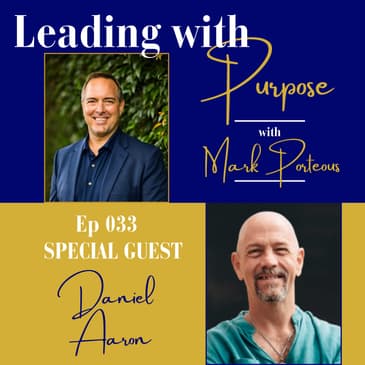
Leadership begins long before anyone chooses to follow us. In this conversation, I'm with Daniel Aaron to explore what it truly means to lead from presence, purpose, and integrity in a world that often feels uncertain and divided.
Daniel shares how spiritual leadership starts with the relationship we have with ourselves before extending into our work, our communities, and the lives we influence. We discuss self-love, stewardship, intentional living, the transformational power of writing, and why becoming the person we want to see in the world is the foundation for creating meaningful and lasting impact.
Keytakeaways:
- Leadership begins with who we choose to become before it shows up in what we do.
- Presence, self-love, and integrity create the foundation for authentic leadership.
- Writing and self-reflection are powerful tools for personal transformation.
- Stewardship shifts our focus from ownership to purposeful responsibility.
- Great leaders intentionally create the future instead of reacting to circumstances.
- Becoming the change you want to see in the world is the essence of leading with purpose.
About the Guest:
Transformational storyteller | Spiritual teacher | Best-selling author | Broadcaster | Black belt in judo | Pacifist | Reverend | Ordained priest. Not religious.
Author of The Art of Spiritual Leadership and The Art of Radiance. Founder of Radiantly Alive - the celebrated center in Bali that became a decade-long home for transformational yoga teacher trainings, events, and immersive retreats. Creator of Masterpiece Life Training™ and Spiritual Leadership & Badass Business™. Host of The Art of Vibrant Living Show.
His work is shamanic: he mines the depths of human experience, surfaces the gold, transmits it. The places where people have been most broken are not failures. They are where the light gets in.
Lifelong yogi. Devoted father. Rebuilt from scratch more than once. Emerged each time more sovereign, more fully himself.
Website: https://danielaaron.com/
Gift/Offer: Stop Affirming. Start Commanding. The Brutal Truth About Why Your Affirmations Are Lies, and the One Sovereign Shift to Make Them Real: https://danielaaron.com/affirmations
About Me:
Hi, I’m Mark Porteous; the Soul Connector.
My stand is for ALL people to recognize themselves as Divine Beings who have chosen the human experience for a reason and to live in alignment with that knowing, so they can THRIVE in their purpose of transforming lives.
I help mission driven entrepreneurs to make their Soul Connections so that they can impact and change the world, scale their businesses to six and seven figures, and enjoy thrilling Soul Success in every arena of their lives.
Connect with me at:
https://www.linkedin.com/in/markcporteous
https://www.instagram.com/mark.porteous1/
https://www.facebook.com/markcporteous/
Take the Soulful Leadership Assessment here: https://markporteous.com/#tve-jump-184964db927
Thanks for listening!
Thanks so much for listening to our podcast! If you enjoyed this episode and think that others could benefit from listening, please share it using the social media buttons on this page.
Do you have some feedback or questions about this episode? Leave a comment in the section below!
Subscribe to the podcast
If you would like to get automatic updates of new podcast episodes, you can subscribe to the podcast on Apple Podcasts or Stitcher. You can also subscribe in your favorite podcast app.
Hello. Today's guest is Daniel Aaron, transformational teacher, entrepreneur, and author of *The Art of Spiritual Leadership* which I have right behind me on my bookshelf. For more than two decades, Daniel has guided conscious entrepreneurs, coaches, and leaders in integrating spiritual wisdom with authentic leadership. His work explores what it means to lead from presence, purpose, and integrity while creating meaningful impact in the world. So you can see why I was anxious to have eager. I like the word eager better to have Daniel here with me. We've been friends for years, and in a time when many people are searching for a different model of leadership. Daniel offers a refreshing perspective that our greatest influence begins with who we choose to become. Hello, Daniel. Welcome to Leading with Purpose.
Daniel Aaron:Ah, thank you, Mark. I'm delighted to be here.
Mark Porteous:So, where is here at the moment for you, Daniel?
Daniel Aaron:That's a good question, and so to give a little context for your audience, and I am in a phase of my life where I am a full-time nomad, and so here in this moment is Maui, Hawaii.
Mark Porteous:That's fantastic, and that is kind of where you've lived, where for most of the time that I've known you, you also are from Cape Cod, right, Massachusetts, Martha's Vineyard area.
Daniel Aaron:Yep, the Vineyard's been an important place for me over many years, and the last decade I've been on Maui primarily.
Mark Porteous:So it's about as far east and as far west as we can be in the United States. And then before we met, you were spent you spent time in Bali as well.
Daniel Aaron:I had 13 years in Bali, and yeah, I've lived in a lot of different parts of the world. And I love that you said furthest extremes of you didn't say extremes, but furthest edges of the U.S.
Mark Porteous:Of course, I'm not talking about Alaska, which is the farthest north, east, and west. I think.
Daniel Aaron:Yeah, I'm with you. I'm with you. I do think I tend to be a bit of an extremist in ways, and extreme times call for extreme measures, perhaps.
Mark Porteous:Well, that's where we are, especially for a lot of people if they base life looking at the news, whether it's the Main Street news, or whatever our many hundreds of choices of selected media are, the world looks pretty messed up.
Daniel Aaron:Yes, and if we go by appearances only, it could be very depressing.
Mark Porteous:Absolutely, and and sometimes even hopeless, and especially I think for a lot of light workers who are wanting to just shine the light and to bring more good into the world, it can be frustrating. You're talking about kind of a a new way of leadership, and you've been talking about spiritual leadership for a long time. What do you see this this time kind of bringing up for leaders, and especially people who are in the personal transformation space, people who are wanting to be light bearers in the world.
Daniel Aaron:It brings up opportunity and responsibility, right? We, as people with big hearts, with a vision for what's possible, what can what we can create in the world, and perhaps in contrast to some of what appears in the in the media, we have the responsibility to to do something about it. And underneath that is to be someone who sees beyond the negative appearances, to vision what's possible, and actualize it through who we are being, right? Which means we have work to do, and yes, work to do in the world, right? Like you doing this podcast is a great blessing to the world, and we have work to do inside ourselves to be someone who is not reactive to that, who's not contributing to the mess that's out there, whose very presence is is light, is upliftment to the world.
Mark Porteous:Yeah, and again, it's really easy to get kind of stuck in in what's happening on outside world. When you talk about spiritual leadership, there's people can have interpret that a lot of different ways. And you're just talking about who you're being. For a lot of times, you know, our audience is often entrepreneurs. It's it's people that are in the transformation space. They're they're coaches or authors, or they support wellness professionals, something in that space. But really, whether you're a mom taking care of a family, or a dad taking care of a family, or that you're out in the the corporate world, or if you're running an organization or a little league coach. How does spiritual leadership? What is that? How do you define that for yourself and for the people you speak to?
Daniel Aaron:Yeah, thank you for asking that because spiritual is a loaded word. You know, it's like it's like love. Everybody has that in their vocabulary, and yet everybody defines it a little bit differently
Mark Porteous:And expresses it differently.
Daniel Aaron:Yeah, expresses it differently, and and it's one of those words that's so often used. It's easy to just kind of gloss over it and glaze down, like, oh yeah, I know what that means. Well, what does it mean? So when I was writing the book, The Art of Spiritual Leadership, I said, well, it it would be useful for me to actually define this, which caused me to go inside and say, "Yeah, what what does that really mean? And I came up with two metrics for it. Right, one is comfort in one's own skin, by which I mean self-love, acceptance of self, ability to be present regardless of external circumstances, and and that might not sound at first like it really goes with leadership or even spirituality. I don't know how people receive that. To me, though, that's one of the most fundamental aspects of being a light in the world. The second part is how much good do we offer into the world? How much love? How much positivity? How much benefit does our presence and our work bring to others.
Mark Porteous:I love that. I love the talking about presence. You're probably familiar with the Enneagram. I've known about it. I've had clients that are experts in the Enneagram, but only really recently, in the last year, felt very confident that I am a tool on the enneagram, and the two gets value or receives value through service. And so, a lot of times, you know, if we can't be a service arm, if we don't, if somebody doesn't need us, then we don't feel value. And what you just talked about with the presence, that's the way to the antidote to that is to realize that as a two, just showing up how my presence is my service. It doesn't have to be in my doing. It's more like you were talking about before, who we're being.
Daniel Aaron:Absolutely, yeah, 100% I'm with you, and it's worth bringing in that who we are being is always radiating out invisibly, without us saying or doing anything. And who we are being is what creates our speaking and our doing. Right? It's like it's like an apple tree or an apple seed becomes a tree, and then the fruit that comes off that are apples, and in the same way, who we are being, and if that, in case that's not clear, what that means for people, identity, identity, or if we want to go New Agey, one's vibration, maybe that's not even New Agey anymore. Who we are being always translates straight down into how we are thinking, how we are feeling, what we say, what we do, and what we have. And you know, in relationship to where we started in this conversation, what we have is the world that's existing right now, and it's full of challenge and conflict and messes, and we all have that collectively because of who we have been being collectively.
Mark Porteous:And I think that that collectively part is is an important part to bring in as well, because it's very easy to to feel separate from everything else, or on the opposite end, to to feel like oh we're we're to blame for this. It's not it's not a blame thing. It's just a an awareness that we are all part of the collective, and then what is our role to to play in it? One of a friend from Ecuador, Scott Baker runs some a place called Minga, and there's an Ecuadorian term there, the Minga, that means to be a part of a community that you have an obligation to the well-being of everyone in the community. And it's not like I have to be responsible for everyone in there, but I have to make sure that if I'm not, someone else is. You know that we're all working together and to find our role. So it sounds like this idea of presence also brings us opportunity to find out more about who we are and how we're actually taking action. Because leadership isn't just about being. Where there's a a. Aspect to it. Tell me more about that.
Daniel Aaron:Yeah, I love that Minga. That's the first time I've heard that, and I completely agree with that. And that's part of what I mean by responsibility. Is and you know one of the the truisms about leadership generally is a leader is responsible for the results. So, if something didn't go the way I want, and I'm in charge, I'm the leader. And whether it was quote somebody else's mistake or not, it's still my responsibility. I'm the I'm the one that created that. So, I love that you brought us to action because yeah, it's easy in the spiritual world to get into what's often referred to as spiritual bypassing, right? And that's an ability to well, in its extreme, I can go meditate in a cave, right? And well, and I can get to very high, blissful, peaceful states. Well, how much does that hold up when I encounter the world, when I get into action, when I'm in conversation, when I see injustice happening in the world, when I see conflict? How well does my peace hold up then? So action in the world in in the in Taoism, it's called the world of 10,000 things, right? In that world, how who am I then, right? How does my being translate into action? So it's both. It's both and just in the same way that we are spiritual beings having a human experience, we're also having a human experience to learn and refine who we're being. So it's it's the marriage of both of those that that creates wonder, that creates possibility, that creates our evolution.
Mark Porteous:That's beautiful, and it's funny. I started off the conversation about where you are in the world, and you talked about the the minimalization, and I love that that you're in a place where you can do that, where you can literally have no belongings. That's a bit of a personal story, but do you mind sharing a little bit about that? Because I think that that will lead into where I want to go with you next.
Daniel Aaron:Thank you. Yeah, I'm an open book, so I'm happy to speak about anything you would like to. And about a year and a half ago, my daughter, 17, senior in high school, she comes into my office, and we'd been in a discussion for you know probably a couple of years about okay what happens after high school and the last plan that she had and there were a few that evolved was well I'm going to go to community college here on Maui and keep living with you for a couple more years and then I'm going to okay so that was in my mind she comes into my office this day, big grin on her face. Okay, she's like, Papa, no offense, but I don't want to live with you anymore. And she lived with me, pretty much just the two of us her entire life. And so when she said that, I laughed because she said it in a funny way. I also had the part of me that's like, no, I don't want you to leave. I want to stay together forever. Quickly, I moved beyond that though to how awesome that she's ready to fly. And then, shortly after that, I said to somebody, "Well, I'm going to be an empty nester. And as soon as I said it, I gagged. I'm like, "I do not define my life by what's missing. What's better language? I am moving into a season of soaring, and I didn't know what that meant at first. And very quickly, I received guidance that was well. What that means is let go, right? Let go of everything, and it's not quite everything. I have got two suitcases worth of stuff, and that became a a new opportunity for me to live with much less than I've ever lived. Well, not much less than I've ever lived with, because when I was in my 20s, I had a long season of nomadic living, right? For the last 18 years, I've been in the householder phase and collected a lot of stuff in that process. So that's what sparked it, and I didn't know what it meant at first, and I'm still learning what it means. One of the things, though, is understanding more what it means to be a steward,
Daniel Aaron:right? And to owning isn't the thing. Like we have the phase of our life where we think owning is important, and eventually we come to. We don't own anything, right? I'm a steward of of this body. I'm a steward of my business. I'm a steward of my daughter when I'm in the father role.
Mark Porteous:I love that perspective because, again, being a steward of anything, when you were first talking about your daughter, I was feeling the same way. Sometimes people feel that about their clients when they their clients they get them where they need to be and then they're off and you're like oh but I want to keep working with you like oh yeah but they're on to their next teacher you know or whatever that might be but when you say not owning anything people think that they own their house and like well you own it but let's see what happens if you don't pay taxes on it so we're we're really just always in a perpetual renting from the government, even our our land and our our house. There's nothing really, and again, eventually we can't take anything with us anyway.
Daniel Aaron:Yeah, exactly.
Mark Porteous:So I'm I'm curious again on this journey where that's taking you, and what what is now emerging for you personally, as a spiritual leader, and how you're showing up, what you're seeing for the next phase and next evolution in your leadership.
Daniel Aaron:Thank you. Well, one of the surprising things that happened for me very quickly into the journey is for the last decade, my I've thought of my occupation as coach, who is also an author, and in this evolution over the last year, that sense of identity switched, and and I still love coaching. I have amazing clients who, yes, sometimes move on. And blessed be that. And authorship. I remembered something I knew from a long time ago. That is my ikigai, my dharma, my greatest gift to the world, and you know, because you write it's it's really easy to put that off, right? For me to think, well, I just need to do this thing more with marketing, with sales, with my business over here, and with with writing and authorship, it's it's a slow evolution. It's a slow process, at least for me. Like we have a common friend who I spoke with last week. He's like, he's like, yeah, I wrote a book over the weekend. I'm like, huh? What? Okay, wow, cool. It doesn't work that way for me. When I write, it's a deep process that goes over quite a long time, at least compared to a weekend.
Mark Porteous:Yeah, and again, I think a lot of people now are using AI as a tool, and there are ways to use it where you can get out a lot of content, and then you can personalize it and make it your own much faster, but there's again something about when no matter how you're writing, especially if you're writing about your own experience, it's a transformational event. Writing a book is is like having a baby; it's a new expression of who you are and what you're bringing into the world.
Daniel Aaron:Absolutely, I have a a client who's an amazing past, and he identifies himself as not a writer, so he's hired a ghost writer to help him complete this book, and great that alone will will produce miracles for him and great service to the world, and part of what I'm working on with him is one. I'm not a writer. Where does that come from, right? A writer, one of my teachers defined for me early in my process of writing, is someone who writes, right? That's the definition. Doesn't say anything about how much or how well or what type. To your point, though, which I think is the most important part of why I'm encouraging him to actually get into the writing is because it is a transformational experience. It's the writing itself is powerful. It's a shift to who we're being, and I would even go so far as it's a shamanic experience, right? It's taking the past and transforming it, alchemizing it, alchemizing ourselves in that process. And yes, the byproduct is a piece of art that can serve many people. The most important part is the alchemy, because who we are being again radiates out into everything we're doing.
Mark Porteous:It's interesting. I was thinking about the actually a friend of mine that. Same person who published your first book, and he was talking about that to be a great writer, you don't need to be a great writer. You just need to be a writer, and you can turn in a C grade writing to a good editor, and they can make that into a an A book, and and that's part of the process. Is you you write out what you want you get your your part out there but unless you are a professional editor I think most professional editors still have somebody else's eyes on it to help you know mature the story and all the other little pieces of it but yeah I think just the idea of limiting and saying oh I'm not going to write or I'm going to need to hand it off to somebody else completely, is again almost spiritual bypassing. I think that that the process of writing it out, and it's great to have a co-author or somebody else that's working with you on it. But like you said, that whole process is evolutionary, and I think I recommend it for everyone. I don't ever like to shit anybody, but I think it's a really great thing if you work with other clients and have their stories or whatever else it is. I think it's powerful for all spiritual leaders to be able to to express it through publishing a book, not just writing, but actually now being a published author, because you were a writer for a long time, and then being a published author is this client of yours. This is his first book, I'm assuming. So he's been writing, but now he'll be a published author as well.
Daniel Aaron:Correct. Yeah, and and it's worth double clicking for a moment on the word author, and and I love what you're saying about why it's so valuable and important. Being an author means well, one being an authority, and that's useful in many ways. It also means being an architect of the world, of the self of the world. It's a designer. It's it implies I'm not reacting to the world right back to where we started talking about the world's a mess. I'm not reacting to it. I am creating it, right? And the the deeper definition of author is, and it's just so profound. And it's worth speaking for a moment about why so many people don't write, don't believe they're a writer, and so much of that is negative conditioning, a lack of self-love, right? And it's one of the easiest places to judge ourselves because when we write, it's it's a direct mirror of what's happening on the inside of us, and so many of us grew up in school systems that gave us red pen syndrome. Red pen syndrome means you're wrong, it's bad, you should have done this, right? And well-meaning teachers or parents or other people in our lives said no, no, no. That's not the right way. And a lot of us internalized that and said, I can't do that. I don't want to do that. And writing is as simple as speaking. One of my writing teachers used to say, if you can write the way you speak to your friends. If you can write the way your mother spoke at the kitchen table, right? That is great writing. Just, just real, just authentic, and everybody has that capacity because everybody can speak. Everybody speaks to other people.
Mark Porteous:I love the the defining around author and and what that is and and around leading. The name of this show is leading with purpose. What what does leading with purpose mean to you?
Daniel Aaron:Thank you. We are always leading, and and it's one of the like basic things that as I dove deeper into leadership, we have a concept often that well leaders are born or leaders are people with positions of authority, right, and that can be true. Though leadership is happening all the time, it starts, of course, with ourself, right? Am I able to do what I say I'm going to do, right? Am I able to have a sovereign presence in the face of challenges, challenges from the outside, or challenges in my mind, in my mind that say you're not good enough, you shouldn't do that, right? That's leadership, and that's where all leadership starts. So we're always leading through our presence. We're leading ourselves. We're leading the people around. It's inescapable. We affect other people, and not just people, all all kinds of beings. So leading is happening all the time, and when you bring it leading with purpose, leadership with purpose, to me that's like, well, let's. What does it mean if we're intentional about it, right? Rather than by default, by conditioning, by habit, what what's our vision for the world? What's our vision for our own lives? What's our vision for the people that we love? Which hopefully is getting to be more and more all the time. So leading with purpose is saying, this is what I would love the world to be right. This is what I would love my life to be. Getting intentional about that, and this is fascinating, Mark, because like the conversations I have with clients and potential clients all the time is, what would you love, right? What do you really desire? And so many people just really haven't invested the time in. This is the future that I would love, and we have the capacity to you know argue with our our mates or our friends about what takeout we're going to order and spend half an hour on that, or what you know movie we're going to watch right over and over again. I mean, 10s of 1000s of hours can go into that, and yet
Daniel Aaron:very few people actually invest themselves in what future would I love to create. And
Mark Porteous:I think a lot of times we don't even really do the work to find out what we want to create. There's so much projected on us of what we think we're supposed to want, that that's a really easy first step or hard first step for some people, just because they don't realize that that's an opportunity to actually choose the vision that they want.
Daniel Aaron:100% yeah. Our power to create is phenomenal, and again, as you said, for a lot of us, there is a lot of conditioning, often from well-meaning people, that don't set your sights too high. I don't want you to be disappointed, right? So you know, and better, better safe. Play it safe. So do this thing that I think is going to work for you. Go for something that feels safe, right? And and so much of your work is about entrepreneurship, and entrepreneurship in itself is a statement that I'm going to create. It's safer to get a job, and there's nothing wrong with a job if if that's what someone really wants. The question is, do we really want it, or is it just because I don't yet know or trust or believe in myself that I can create what I would love.
Mark Porteous:So well said. I really love that distinction. And Aaron, for anybody that may want to learn more about you, we talked about the art of spiritual spiritual leadership. I'll put the links down below for that. How else can people reach out to you? What else can they look for down there?
Daniel Aaron:Thank you. Yeah. Well, my website is the easiest way: danielaaron.com and it's Aaron like A A Ron. And what else is what else is there? What else is possible? Well, certainly I work with a select few people to help them create what they would love to create in their lives. Sometimes it's called coaching. I'm just about to release my next book, which is called Nothing Left to Carry, and and it represents for me an evolution in my own writing, where I was before was personal spiritual development, and and I love what I've written in that realm. And in the last year, part of what I've learned is better for me now is what could be called literary memoir, which I didn't even know what that was. I just started knowing that for me to really impact in the way I would love to to create what I would love in the world, it's now time for me to be more risky, vulnerable, transparent, to go deeper in myself, and so what I'm what I'm working with in my writing now, and there's a blog on my website too with shorter pieces, is is a kind of writing that is, as I mentioned earlier, it's sort of alchemical for me, and gives the reader the ability to alchemize in themselves, and that's one of the most amazing things about stories and writing is we have an an an easy sort of passive way to evolve. When we enter someone else's story, it is it takes the pressure off us in a way and allows us to. Transform our own material, even though the story isn't us; it's not our material. Yet, the result is loving ourselves more, being brighter in the world, becoming more of a spiritual leader.
Mark Porteous:Beautiful, and again, there's different people on different places on their own path, some further along than others. Somebody who might be hearing this and just kind of awakening to their own path. What do you recommend as a first step to getting started to identifying what you really want?
Daniel Aaron:Oh, what a beautiful question! Well, as we've been speaking about writing a lot in in this conversation, one basic thing is to journal. Julia Cameron talks about the morning pages, and it's one of the most valuable practices I've had in my life. Is just every morning, longhand writing a few pages and nothing great, nothing that I'm looking to publish. Just this is what's going on inside me, and it's so easy for us as human beings to have all of our activity going pinging around in our head, and something magical happens when we express it out on the page, it creates a movement, right? And one of and I love working with deliberate questions in writing. And to your question, one of the great questions to ask is, what would I love, right? And not what would I like, or not what would I want. What would I love? What would I love to create because the word love powerfully taps us into into passion, into truth, something deeper, and that's available for everybody. I call my business the Art of Vibrant Living, and the problem I see the biggest problem I see in the world is so many people are on autopilot. It's what I call the cult of meh, or mediocre monotony. Just getting by, can't complain. It's all right. Got to pay the bills, and I get it. And there's so much more available. Vibrant living, thriving is our birthright. It's our destiny. So asking that question, what would I love to create? Often, incredibly valuable.
Mark Porteous:That is so good, Daniel. I always enjoy spending time with you, just having a conversation. Again, for all of you listening, I hope you feel inspired. We'd love to answer any questions or comments. We'll make sure that Daniel gets to see them as well. So please share your comments or questions below, Daniel. For everybody listening, what's the last word? What would you like to leave everyone with?
Daniel Aaron:Last word is love. That's the word. That's what matters most. I've been studying again the Bhagavad Gita, right? One of India's one most spiritual books, Bible, and in connection with studying again Mahatma Gandhi, right? And the way that man transformed himself from somebody who was shy, inept in many ways, who abused his wife, and the way he became, and and his main teacher was the Bhagavad Gita. The way he became someone who showed up as love in the face of just unbelievable conflict and adversity and hate, right? So that line that we love to quote, right? How to change the world? Be how does it go? Be the one say you want to see in the world.
Daniel Aaron:Yeah, be thank you. I've been given to
Mark Porteous:Gandhi, and it's just yeah,
Daniel Aaron:Yeah, and it's it's so profound. Be the change you want to see in the world. It's another one of those words like love or spirit that, well, we all have a definition of it. We've all heard it, and it's easy to glaze over. But be the change you want to see in the world means become love, right? No matter what is happening, Gandhi, MLK Jr. Jesus, great models for this, and that's possible for all of us.
Mark Porteous:Well, that is a drop the mic moment. Thank you so much, Daniel. I appreciate you being here on Leading with Purpose. Thank you for watching and listening. We look forward to reading your comments and responding. Thank you for now. Keep shining your light.
Daniel Aaron:Thank you, Mark. Aloha.